
Helpsheet 4: Paperwork, record keeping and digital reporting
Last Updated on 7 July 2026
Things to keep
Everyone hates filing, so…
Set up a filing system that’s easy to top up as you go along, and easy to understand if you need to look something up later.

If you’re paid PAYE it’s a good idea to hold on to the following information:
- pay slips
- P60 (each tax year if you’re employed on 5th April)
- P45 (on leaving employment, though not all freelancers get one)
- Bank statements
- Contracts and other agreements

Sole traders and people running companies need to keep hold of:
- A record of income and expenses for the business
- Proof of purchase for business-related expenses
- Proof of turnover – i.e. invoices
- Access to bank statements
- Contracts and other agreements
These are a minimum, and you should keep them for at least 6 years. This is in case you are audited by the tax office, or you have a query about tax. You can keep things digitally – no need to clutter up your attic with boxes of receipts.

If you’re running a Limited Company there are specific record-keeping requirements from April 2028.
Read David’s blog post on this here >
What are business-related expenses?
Legitimate expenses (or ‘business costs’) can be recorded so that they are ‘offset’ against tax. This means they are deducted from your turnover at the end of each tax year, making your taxable profit smaller.
Every business is potentially different, so technically every business’s costs could be different. But there are parameters:
View outline of business expenses for self-employed people on gov.uk >
View self-assessment help sheets on gov.uk >

Update June 2026: Because of the US war in Iran and the rise in fuel costs, the government has raised the mileage rate for using your car for a business journey.
It is £0.55p per mile (up from £0.45p) for the tax year 2026-27, backdated to 6 April 2026.
Sole Traders can also make use of special flat rates which are called simplified expenses. These include a sliding scale of flat rates for ‘use of home’ which covers heating and lighting the place in your home where you work.
The rates are not particularly generous, but they cut down on the paperwork. (Simplified expenses are not available to Limited Companies.)
View simplified expenses for sole traders >
We have set up an online calculator to help you work out sole trader ‘use of home’ expenses.
The £1000 Trading Allowance
Sole Traders also have a Trading Allowance of £1000, which means you don’t have to report precise expenses figures on the tax return.
Because the trader allowance is £1000 per tax year, you normally don’t have to register as a sole trader until your sole trader trading income is more than £1000.
You may want to voluntarily register for self assessment as a sole trader if your income is less than £1001 because:
- you have to give your Unique Taxpayer Reference (UTR) number to a client before they give you freelance work
- you want to pay Class 2 National Insurance contributions to build up eligibility for certain benefits like maternity allowance or state pension
- you want to claim tax-free childcare (see this excellent explanation on the LITRG website >)
This can be beneficial if you have low expenses. But you still need to keep records so that you can tell if your actual expenses are more than £1000. You might otherwise end up paying more tax than you need to!
We have a spreadsheet for recording turnover and business expenses, with a guide to the expense categories and a tab for recording any costs in each category:
Download sole trader income and expense account spreadsheet >
Read a great overview of the Trading Allowance from the Low Income Group >
View Trading Allowance on gov.uk >
‘Making Tax Digital for Income Tax’ (MTD for IT) – a big change for sole traders and landlords

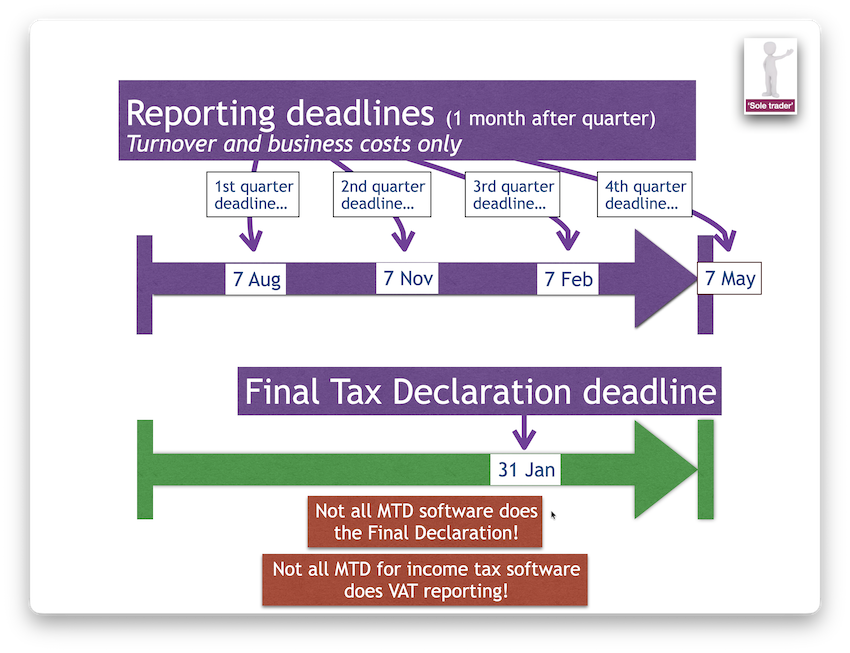
HMRC is introducing a new system of tax reporting. Eventually nearly every sole trader (or landlord) will have to:
- report income and business expenses every 3 months
- use HMRC-authorised ‘cloud accounting’ software to do it
The date for reporting income tax in this way by some sole traders is April 2026 (delayed countless times for countless reasons).
We have moved all our MTD information to a special MTD section.
Click here to read all about Making Tax Digital for sole traders:
https://davidthomasmedia.com/resource-hub/making-tax-digital/
Can PAYE freelances get tax relief on costs?
HMRC is very suspicious of people who are paid as employed wanting to get tax back on expenses.
In their eyes it is the employer’s responsibility to reimburse their employees for out-of-pocket costs.
However there may be some scope to get tax relief in some categories of expense, as long as the employer is not reimbursing you.
You won’t be reimbursed for the whole expense – that’s not how tax relief works! But you might get a slightly lower tax bill, or a tax rebate at the end of the year.
To make things clearer, HMRC changed their systems slightly in December 2024, and you can read more about the process on this page:
Don’t get caught out (HMRC website) > (Opens in new tab)
Note that you need to have proof AND a justification for asking for the tax relief.
Find out more:
www.gov.uk/simplified-expenses-checker – Flat Rate expenses tool for car journeys and heating/lighting/use of home
www.gov.uk/…HRMC…/contact/self-assessment – Contacts for HMRC if you need guidance when filling in a tax return
www.gov.uk/…/self-assessment-helpsheets-main-self-assessment-tax-return
https://davidthomasmedia.com/resource-hub/making-tax-digital/ – Our special guide to Making Tax Digital for sole traders
www.gov.uk/…-making-tax-digital – loads of MTD info
www.gov.uk/…/using-making-tax-digital-for-income-tax – how to use MTD for income tax
We’re not pushing FreeAgent in particular, but it’s the one David Thomas Media uses. If you decide to go for it, you can get 10% off by clicking this button:

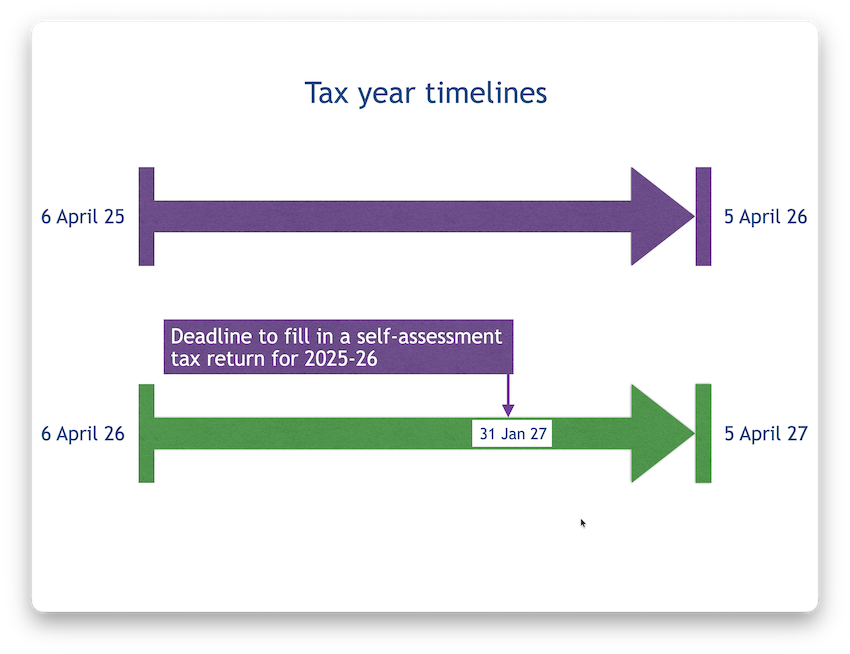
Income tax reporting example – Sole Traders:
Before Making Tax Digital:
After Making Tax Digital:
NB: David Thomas Media Ltd is not responsible for the content of other sites nor any financial advice provided by them.